What full pool means
“Full pool” is not the top of the lake. It is the level a reservoir is meant to hold in normal weather, with room above it kept empty for floods.
A reservoir is built in layers
Most federal reservoirs are divided into horizontal zones, each with a job. From the bottom up:
- Inactive or dead pool. Water below the lowest outlet in the dam. It cannot be released through the dam at all, so it is not counted as usable storage.
- Conservation pool. The working water: what the lake stores for water supply, hydropower, navigation, irrigation and recreation. Its top is what most agencies call full pool, normal pool or top of conservation.
- Flood control pool. Space above full pool that is kept empty on purpose. When heavy rain arrives, the dam holds the extra water here so it does not flood towns downstream, then lets it out over days or weeks.
- Surcharge. Above the flood pool, up toward the top of the dam. Water reaches it only in extreme floods, when the spillway is carrying water out as well.
Of the 340 lakes on this site, 305 have a published top of flood control pool. On those lake pages, the gap between full pool and the flood pool top is the room the dam has left for the next storm.
Above full pool is not “extra full”
When a lake page says a lake is several feet above full pool, the reservoir is doing flood work. The agency is storing water that would otherwise have raised the river below the dam, and it will release that water as soon as the river downstream can take it. Lake levels above full pool usually fall quickly once the rain stops. Boat ramps, beaches and campgrounds near the shore may close while the water is high.
As of November 4, 2026, 77 of 329 lakes with a published full pool sit above it. These are furthest above:
| Lake | Level (ft) | Vs full pool |
|---|---|---|
| Cochiti Lake NM | 5,356.48 | 11.0 ft above |
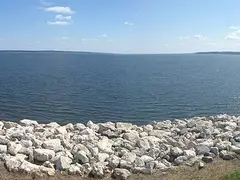 Sardis Lake MS | 245.24 | 9.2 ft above |
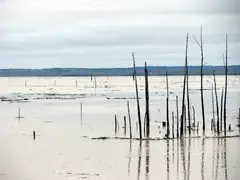 Grenada Lake MS | 201.69 | 8.7 ft above |
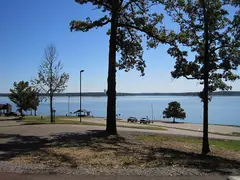 Enid Lake MS | 238.19 | 8.2 ft above |
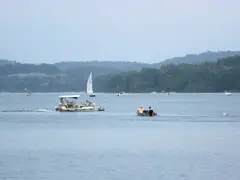 Atwood Lake OH | 927.64 | 6.2 ft above |
 Lake Red Rock IA | 747.68 | 5.7 ft above |
| Crooked Creek Lake PA | 843.08 | 5.7 ft above |
| Tuttle Creek Lake KS | 1,080.60 | 108.0% full |
Below full pool is not always a drought
Many Corps of Engineers lakes lower full pool itself in autumn, so a lake can be several feet under its summer level and exactly where it is meant to be. That is why every lake page also compares today's reading with the normal for the calendar date: the median of the same date in up to 30 past years. A lake that is below full pool but about normal for the date is behaving as usual. One that is much lower than usual for the date is genuinely low. Today 99 of 328 lakes with enough history are lower than usual for the date. See the full ranking.
The seasonal change in full pool is explained in why lakes are lowered in winter.
Percent full
Where the Corps publishes storage in acre-feet, a lake page also shows percent of conservation storage: the water above the bottom of the conservation pool as a share of the space up to full pool. This is the most honest “how full” number, because a reservoir shaped like a canyon holds far less water in its bottom ten feet than in its top ten. A lake 10 feet below full pool can still be 80% full by volume. Where storage is not published, pages show feet only.
Natural lakes have no full pool
Lakes without a controlling dam, such as Great Salt Lake and Lake Champlain, have no designed full pool. Their pages compare the level only with the normal for the date and with past years.
More lake level guides
- Why lakes are lowered in winter: Why many Corps lakes drop several feet every fall on purpose, and which ones are drawn down the most.
- How to read a lake elevation: What a reading like 1,071.3 ft means, why lakes cannot be compared by elevation, and what NGVD29 and NAVD88 are.
- Will my dock or ramp be dry?: A tape-measure method to find the elevation of your dock or ramp, and what to watch for when the water is low.
- Who decides how full a lake is: How the Corps of Engineers and Reclamation decide how much water to hold or release, and why a lake can fall after rain.
Lakes people check most